elevation ~800 m
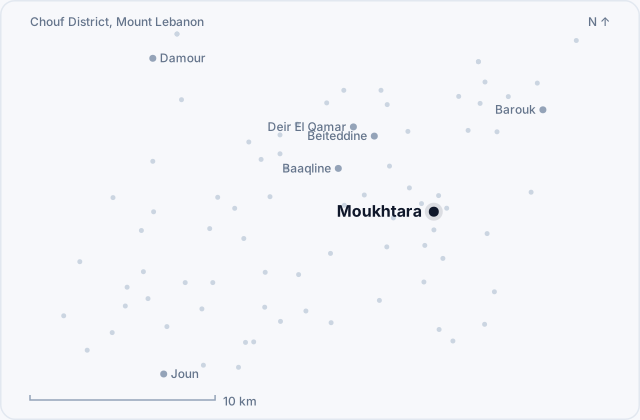
Moukhtara is in the Chouf District of Mount Lebanon, about 50 km from Beirut, about a 50-minute drive. Its closest Chouf neighbours are Botmeh (~0.7 km), Jdeideh El Chouf (~0.8 km) and Ain Wzein (~0.9 km).
Shopping from Chouf-area stores and a directory of trusted local trades serving Moukhtara — without the trip out of the Chouf.
Free · works on weak signal · no app store needed
Moukhtara is a village in the Chouf district of Mount Lebanon at about 800 m, some 50 km from Beirut. It has been the seat of the Jumblatt family since the family settled in the region in the fifteenth century and is regarded as the de facto capital of the Chouf; its best-known landmark is the stone-built Moukhtara Palace, a water stream running through its structure.
Moukhtara is a Chouf village regarded as the district's de facto capital — seat of the Jumblatt family and site of the Moukhtara Palace, built in the 17th century and rebuilt in the mid-19th. It has a mixed Druze and Christian population and is the hometown of Walid Jumblatt, leader of Lebanon's Progressive Socialist Party.
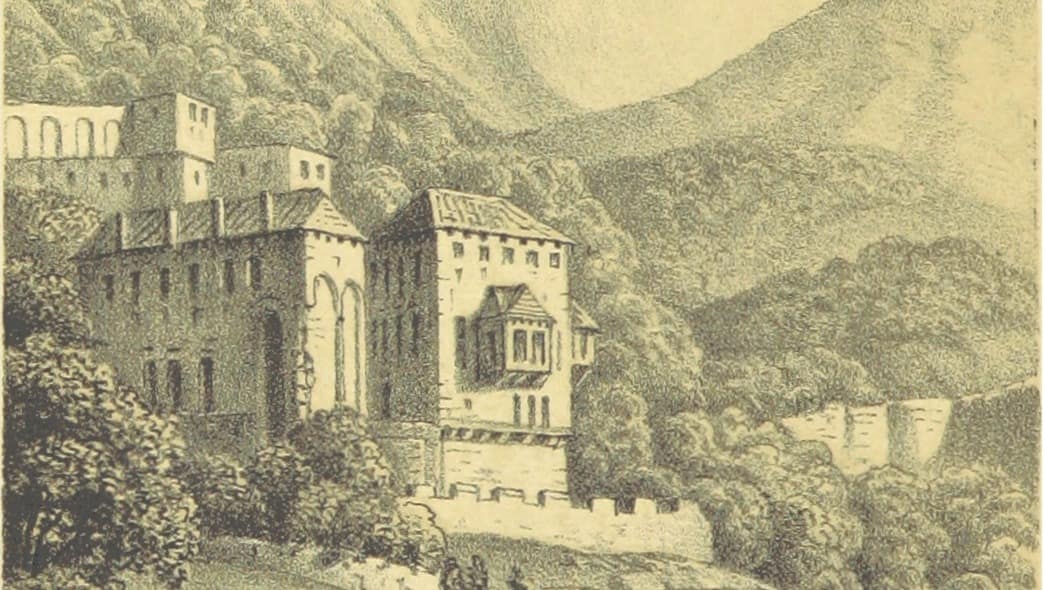
Moukhtara is the historic seat of the Jumblatt family's palace, depicted in 19th-century illustrations. An archaeological excavation in 1963 uncovered Neolithic flint tools — daggers, arrowheads, sickles, and axes — establishing the site's prehistoric significance. Regarded as the de facto capital of the Chouf, it has been the Jumblatts' base since the family settled in the region in the 15th century.
378 flint pieces studied
The flint tools found at Moukhtara were studied as a set of 378 pieces. They include daggers, arrowheads, sickles, axes, chisels, picks and awls. Jacques Cauvin dug the site in 1963 and published it that year in the journal L'Anthropologie.
Source: Wikipedia: Moukhtara
The archaeologist James Mellaart wrote that the heavy tools from Moukhtara were not found with pottery. He suggested they may be older than the Pottery Neolithic of Byblos.
Source: Wikipedia: Moukhtara
Moukhtara means "the chosen". Destination Shouf says the name recalls a sheikh of the Jumblatt family who chose this spot for his palace grounds.
Sources: Destination Shouf: Moukhtara · Discover Lebanon: Mukhtara
1663 the date one guide gives
Discover Lebanon dates the palace as it stands to 1663 and says it rises on very old remains.
Unconfirmed The guides disagree on what lies underneath: one says a Roman citadel, another a Frankish castle.
Sources: Discover Lebanon: Mukhtara · Lebanon Traveler: palaces in Lebanon
1825 the year it fell
Lebanon Traveler says the palace was destroyed in 1825, during the struggles between the Druze sheikhs and Emir Bashir Shihab II, and that Florentine artists rebuilt it in the 19th century. Discover Lebanon dates the restoration to 1842.
Sources: Lebanon Traveler: palaces in Lebanon · Discover Lebanon: Mukhtara
The palace mixes Oriental and Italian styles. It is known for its coloured glass, verandas, marble columns and decorated arches.
Source: Destination Shouf: Moukhtara
1788 richest lord in the mountains
Discover Lebanon says that by 1788 the young Sheikh Bashir Jumblatt was the richest lord in the mountains around. By 1810 he matched Emir Bashir Shehab II in wealth and power. It traces the family's fortune to silkworms and to the sheikh's control of the mountain's revenues.
Source: Discover Lebanon: Mukhtara
1923 became leader at 32
In 1923, at 32, Sitt Nazira Jumblatt became the leader of the Druze, holding the role until her son Kamal could take it. The French called her "the Lady of the Palace", and her home at Moukhtara became a stop every visitor had to make.
1507 end of the Mamluk period
Birket el-Arouss is a stone bridge from the end of the Mamluk period. Lebanon Traveler dates it to 1507 and calls it one of the oldest and most striking in the valley.
Unconfirmed A local tale says every new bride was bathed in the basin by the bridge, which gave it its name. Discover Lebanon: Mukhtara
Sources: Lebanon Traveler: the Barouk River trail · Discover Lebanon: Mukhtara
The Baddé Bridge, from the late Mamluk and early Ottoman years, once linked Moukhtara to the villages on the western slopes of the Barouk valley.
Source: Destination Shouf: Moukhtara
4 Ottoman water mills
Four Ottoman-era water mills stand along the valley trail. Using only the force of the water, they made olive oil and flour until the middle of the 20th century.
8 km of old paths reopened
Volunteers opened 8 km of paths in the Barouk valley, partly along old Mamluk and Ottoman roads, and archaeologists restored four bridges. The trail opened in spring 2011. One way in starts at the Church of Our Lady in Moukhtara.
4 black granite columns
Further down the same valley, where the Aray and Barouk rivers meet, a Roman temple lies under metres of river deposits. Four black granite columns and part of its sacred wall still show above them.
2 churches
Away from the palace, Moukhtara is known for its traditional houses, its old oil presses and its two churches.
Source: Destination Shouf: Moukhtara
A stone palace of three large buildings, built in the 17th century and rebuilt in the mid-19th, that dominates the town and is one of the Chouf's main touristic landmarks. A water stream passes through its stone structure and feeds a massive pool set above the palace — hidden from street level, it can only be seen from above in satellite imagery such as Google Maps. The palace has its own hammam, a garden holding a collection of Roman sarcophagi, and a waterfall that feeds an ornamental pool. Some of its public reception rooms are at times open to visitors. When the head of the family is in residence, he traditionally hears the petitions of his Druze followers at weekends.
~50 km from Beirut · ~50 min drive
The town of Moukhtara is in the Chouf district of Mount Lebanon, Lebanon, at around 800 m elevation.
Moukhtara sits about 800 m above sea level.
Moukhtara is about 50 km from Beirut, roughly a 50-minute drive.
Moukhtara is roughly 25 km from Saida (Sidon) in a straight line.
Notable people connected to Moukhtara include Kamal Jumblatt, Walid Jumblatt, Nazira Jumblatt.
Landmarks in Moukhtara include Moukhtara Palace (Jumblatt Palace), Neolithic archaeological site, Moukhtara Development Services Center.
Free · works on weak signal · no app store needed
More trades serving the Chouf area, reachable from Moukhtara:
Listing yourself on Chouf App is free, your number stays private, and it takes about a minute. Customers find you in the app and tap to call.
List your trade or place in Moukhtara — freePresence is a managed page on chouf.app that we build and keep current, so customers in the Chouf find you when they search.
Get your Moukhtara business found online