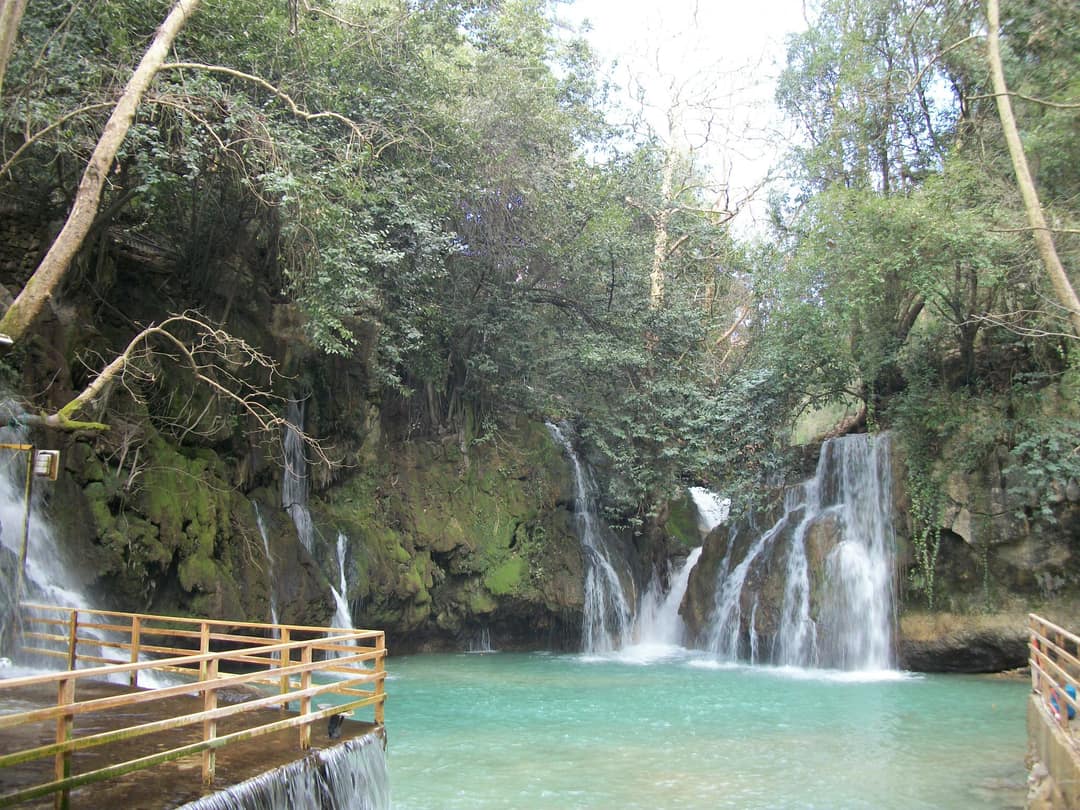
also spelled Baakleen, Baaqlîne, Baakline · elevation ~915 m · area ~12.42 km² · population ~30,000
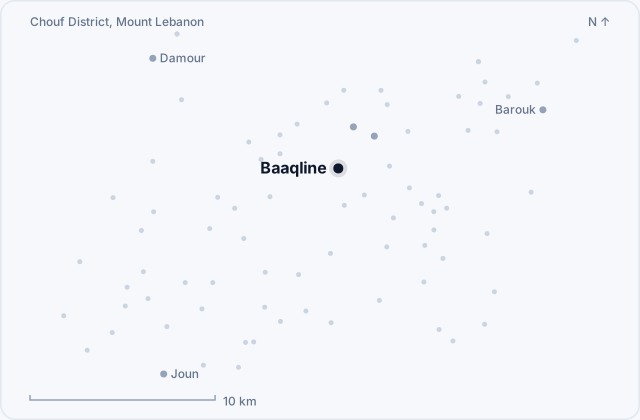
Baaqline is in the Chouf District of Mount Lebanon, about 43 km from Beirut, about a 40-minute drive. Its closest Chouf neighbours are Atrine (~2.0 km), Ainbal (~2.0 km) and Deir El Qamar (~2.4 km).
Shopping from Chouf-area stores and a directory of trusted local trades serving Baaqline — without the trip out of the Chouf.
Free · works on weak signal · no app store needed
Baakleen, also spelled Baaqlîne or Baakline, is a prominent Druze town in the Chouf District of Mount Lebanon, about 45 km southeast of Beirut. It rises across seven hills overlooking the Chouf coast (Damour and Khalde), and borders the Iklim el-Kharroub region to the south and Deir el-Qamar and Beiteddine to the north. The town sits between 850 and 920 m of elevation, covers about 1,242 hectares, and counts around 30,000 inhabitants. A river runs through its valleys, and the territory is fed by springs at Baarouk, Sakanaiyeh, Hzour, Hattab and Anj el-Nahleh, the Maloul water channels, the old Qaryeh source, and several artesian wells. Local agriculture centres on olives, apples, grapes, vegetables and stone fruit. Baakleen was the first capital of the Maan emirate, and its municipality has declared the town's pine-and-oak forest a HIMA — a community-protected natural site — to preserve its biodiversity and cultural heritage.
The name's origin is Syriac, meaning 'the district of the bends'. Popular tradition holds that the Maani emirs who settled it set two watch-posts (ma'qilayn, 'two strongholds') on two hills overlooking the sea, hence 'Aqlin', which became Baaqline.
Baakleen was the first capital of the Maan emirate in Mount Lebanon, and its old serails, palaces, restaurants and summer resorts still bear witness to that rank. Since the election of its municipal council in 2016, the town has led an initiative — in partnership with the Environment for Life Association (EFL) and with funding from the Global Environment Facility's Small Grants Programme (GEF–SGP) and UNDP — to declare its pine and oak forest a HIMA: a community-protected natural site safeguarded from fires, irresponsible cutting and abuse against its trees, birds and animals. The HIMA was formally declared by Baakleen Municipality as a prelude to its classification as a NATURAL SITE under the Ministry of Environment, and a 2022 biodiversity study (with biodiversity panels linked to the baaklineforest.guide website via QR codes) documented its species and named heritage sites for visitors.
1987 opened as a library
Before the Second World War, the Grand Serail was the town's main government building, with a court, a prison and a gendarmerie post. It was restored and opened as a public library in 1987, at the initiative of Walid Jumblatt.
Source: BAM: Baakline National Library
The library stands in a heritage building put up under the Ottomans in the 1890s.
Unconfirmed The exact year differs: Al-Jarida says 1897, Destination Shouf says 1890.
Sources: Al-Jarida: the Baakline library · Destination Shouf: Baakline
2 copies of each book
Al-Jarida reports that two copies of every book published in Lebanon with an ISBN go to the Baakline library, which catalogues its shelves by the Dewey system.
Source: Al-Jarida: the Baakline library
1725 its oldest book
The oldest book a visitor from Al-Jarida was shown in the library's rare books section is in French and dates from 1725.
Source: Al-Jarida: the Baakline library
Al-Jarida calls Baakline's the only national library under the Ministry of Culture.
Source: Al-Jarida: the Baakline library
1925 capital of the Chouf
An-Nahar says the library building was the Chouf's government centre when Baakline was the seat of its qaimaqam under the Mutasarrifate. Around 1925, at the start of the Mandate, the paper says Baakline became the capital of the Chouf.
Source: An-Nahar: Baakline
Under Ottoman rule, Baakline was one of the main towns again. Destination Shouf says it served as the summer capital of the Druze qaem maqam, who governed in the Sultan's name.
Source: Destination Shouf: Baakline
Destination Shouf says a shortage of water drew the Maan emirs from Baakline to nearby Deir el-Qamar, where they built palaces and a mosque that still stands in the town square.
Source: Destination Shouf: Baakline
1954 became Sheikh al-Aql
Rashid Hamada was born in Baakline in 1894 and worked as a judge. On 16 May 1954 he became Sheikh al-Aql, a head of the Druze community, and held the post until he died in 1970.
Source: Areq: Rashid Hamada
1591 building began
An-Nahar dates the start of the Hamada palace to 1591. It was restored by Sheikh Hussein Hamada the Elder and his sons, then again after the 1956 earthquake cracked some of its wings. It is on the Directorate of Antiquities' list of heritage buildings.
Source: An-Nahar: Baakline
Dar Taqi al-Din is a heritage house with work from several periods. The latest additions are by the architect Assem Salam.
Unconfirmed Arabic Wikipedia starts its building in the 16th century. Destination Shouf dates the house to 1830.
Sources: Arabic Wikipedia: Baakline · Destination Shouf: Baakline
The Greek Orthodox Church of St Elias has stood in Baakline for about three centuries.
Unconfirmed Destination Shouf dates it to the end of the 17th century, An-Nahar to the start of the 18th.
Sources: Destination Shouf: Baakline · An-Nahar: Baakline
25 Lebanese liras on the note
The village water source was built in 1890 in a Gothic style with a round dome. Destination Shouf says it was once printed on the Lebanese 25-lira note.
Source: Destination Shouf: Baakline
1562 date on the tombs
Destination Shouf lists old tombs in Baakline, decorated with carving and dated to 1562.
Source: Destination Shouf: Baakline
4 named sites
Arabic Wikipedia says digs at al-Salib, al-Jarid, al-Qashaya and Ain Hattab turned up Roman and Byzantine remains.
Source: Arabic Wikipedia: Baakline
An-Nahar calls embroidery one of the best-known traditional crafts of the town.
Source: An-Nahar: Baakline
The Shouf Atelier, run by a Baakline charity, works in what was once the Dahouk family palace.
Sources: Arabic Wikipedia: Baakline · Destination Shouf: Baakline
An-Nahar lists a small town economy of olive presses, knitting and clothing workshops, wool, ironworks, candle making, wooden furniture and marble saws.
Source: An-Nahar: Baakline
Arabic Wikipedia counts among the town's people the writers Said, Khalil and Sulaiman Taqi al-Din and Nayla Hamadeh Tueni, the singer Rami Ayyash and the lawyer Amal Alamuddin. It says they earned Baakline the title "city of cultural exchange".
Source: Arabic Wikipedia: Baakline
أبو حاطوم، حاطوم، أبو اسماعيل، أبو ثين، أبو رجاس، أبو شقرا، أبو شهلا، أبو عجرم، أبو عيّاش، أبو مطر، بذور، تقي الدين، حرفوش، حسون، الحلبي، حمادة، حمزة، حميدان، خضر، الداهوق، الدمشقي، راجح، رضي الدين، سلوم، سليم، الشامي، شمس، الصبّاغ، صلاح الدين، الطويل، عامر، عبد الصمد، علم الدين، الغصيني، القعصماني، العيد، النجّار، ولي الدين، حدّاد، الخوري، طنب، عمون، غريّب، نمور
The pine, oak, terebinth and olive forest that wraps Baakleen on rich, varied hills — an iconic natural site of the town since antiquity, declared a HIMA (community-protected natural site) by Baakleen Municipality as a prelude to classification as a Natural Site under the Ministry of Environment. The forest is divided into three sections — Eastern Station, Western Station and Forest Depths — and is dotted with named points whose names have been passed down through the generations. Visitors reach it through marked entrances under the supervision of an accredited environmental guide and ranger appointed by the local authority; the rules forbid bringing domestic animals, camping or campfires, collecting flora, cutting trees or shrubs, hunting, littering and smoking.
The primary entrance of the forest, reached through a gate historically known as the Zamoukah or Faraj el-Harj, set at the Boughaz — a south-westerly air corridor where the mist enters the forest like a steep cascade. The station opens onto a clearing shaded by pine, juniper, terebinth and oleaster, and contains the eighteenth-century lime kiln (atoun) that is among Baakleen's rare and finely-preserved heritage features, and a traditional gathering place for farmers.
A newer terrace fitted with a tile-roofed wooden rest house overlooking the valley that links the forest to the neighbouring village of Kfarazi. It serves as the gathering point for arriving visitors before they head into the forest's geography, in its crisp, clean and gently cold air. From here branch out several footpaths and tracks weaving through the forest's arteries — old, simply built and serviceable, with some believed to date back to the Roman era. Ruined rooms scattered along the station once served as shelter during heavy rain and storms. Western viewpoints overlook the deep valley towards the seashore, and most are thought to have served as observation and watch posts. At the bottom of the forest stand the remains of another, ruined lime kiln.
The deep interior of the forest, reached by walking groups along uneven branching trails and only under the supervision of the accredited environmental guide and ranger appointed by the municipality. The depths are where the heritage names and the most striking natural phenomena of the Hima cluster.
Also called Laatoun, Yatoun or Toun, the Atoun is a circular dry-stone structure topped by a domed chamber, built no less than three metres high outside the villages and dwellings. It was used to burn and roast limestone until it turned into soft, pliable, smelting-grade stones — used to plaster the interior and exterior of houses (before modern cement), mixed with mud and salt. Burnt limestone also had another use: it was placed at the bottom of wells filled with rainwater pouring off house roofs to fully sterilize the water from microbes, and the well walls themselves were coated with a lime solution for the same purpose. The Atoun at the main entrance of the Baakleen Forest is among the rare and finely-preserved examples in Lebanon.
Remains of an older, smaller and ruined lime kiln near the main entrance of the forest. Nothing definitive is known about it, and it does not match the specifications of the larger main Atoun.
Located next to the Atoun and used to make natural charcoal — a household need across the village. From this ancient craft comes the old saying, 'Oh you blackener, oh you forgiver,' which our forebears repeated. The craft itself has all but vanished, surviving only with a few traders. The word 'mash'harah' goes back to 'tash'hir' ('blackening') — the soot that blackens human skin and dirties clothes when touched by charcoal, smoke or its ashes, the dusty residue called 'al-ghaffar.'
The hyena was known as 'the forest's broom' or its scavenger, swallowing the carrion left behind by other animals along with some pungent plants. It is distinguished by its powerful jaws, the sharp, crushing teeth, the foul shape and rank smell — and it has become rare today.
A reference to a ruined building believed to have served as an observation or surveillance point used to remotely sense the forest's movements.
In the local dialect, 'el-Shouar' designates the many cliff edges in the Baakleen Forest that lie at the heart of nature's basic formation. The cliff descents vary in height: some are sharp, some vertical and dangerous, ending in a deep abyss — calling for caution, care and watchfulness on approach.
Believed to have been paved at the time on the pattern of similar stairs of the Roman era, and is thought to have been put back into use during the Chehab (Choueizani) Ottoman period.
A small dark hollow into which any wandering animal can take refuge to feel safe, where it can rest a while or shelter itself from a sudden storm or rainfall.
A refuge where jackals shelter their young at nightfall, lying down with them and uttering cries called 'al-Wahaa' before scattering to hunt for food.
Passers-by feel its humidity and freshness; the corridor is shaded by dense trees that hover over rocks of various sizes, protecting them from the sun's heat and keeping them cool.
These mimic the many veiled and hidden phenomena in the forest's depths — phenomena that need contemplation and imagination to understand, and that go hand in hand with what we see with the naked eye.
You hear them while walking alone or with company who prefer silence to talk. Lend an ear to the forest's voice and you will hear its echo; volunteer praise and it answers you back.
Pausing briefly in this place forces you to listen carefully to the eloquence of what the forest's atmospheres are saying through the aesthetics of expression.
A lesson from the culture of nature in how its stillness composes and orders itself so as to give creatures a teaching they can rise through, gaining the capacity for deeper guidance.
Part of the great cosmic energies — the breezes that part chests, revive hearts and breath, sing of the unseen to revive the spirit, renew hopes and open horizons.
Likened to the human body: a valley has a height, a head, peaks, pegs and arteries, a frame, nerves and movement. The belly is the bosom that embraces and shelters all who seek refuge in it.
A hollow carved by water cascading from the heights of the mountains in a winter stream. Named after the doves (yamam) that gather there year-round to drink from the water that remains in a side pool shaded by branches and leaves.
Set along all of the forest trails — small spots where one can sit on a rock or beneath a tree to catch one's breath and take a rest after the effort of walking, before resuming the hike through the branching paths in the heart of the natural forest.
A narrow corridor between two ridges, and a thoroughfare of clean, refreshing air that threads through the branches and offshoots of the trees, reviving the biological diversity of the forest's animals, birds and humans, and stirring vitality, rest and renewal in their cells.
Scattered across the Baakleen Forest, lodged in every corner — in the rocks, beneath the soil, between plants and on tree trunks. They are an integral part of life in this patch and contribute to its ecological balance.
From the canid family. They prefer to stay hidden by day and emerge at night, leaving their unmarked lairs to search for prey and food for their young.
From the main entrance of the forest towards the dome of 'Sahn al-Rizz.'
Bearing left from the main entrance of the forest towards the dome of 'Tine Amaiss.'
Leading to where the Right and Upper Trails meet at their ends.
Leading to the source of Ain el-Mdaileb, above Kfarazi.
The point where you stop, taken with the grandeur and beauty of what your eyes reach, and let imagination roam in the boundlessness of creation.
The fox digs out a den with its claws to retreat to as a safe home; it stashes its young and some food there, and even creates small escape passages for use in exceptional cases — testimony to its cunning and intelligence by divine instinct.
Secrets the forest does not divulge except to those it trusts — a peaceful traveller longing to share in her life and bow with her in the kingdom of the Creator, mindful to guard her secret as a protector of her precious self.
The story of the forest's keepers (the natour and nawatir) — a band of local forest watchmen, recognised under the administrative system of Mount Lebanon at the end of the Chehab era. The most famous of them in Baakleen at that time was the warden Abu Mota'ab al-Eda, known in local lore as 'Qaher al-Dabbaa' (the Hyena-Vanquisher) for his courage in facing the forest's beasts — wolves, wild boars, hyenas, jackals and snakes alike. A statue at the forest captures him, with a hyena hanging across his shoulders.
An interpretive website (baaklineforest.guide) linked to QR codes installed throughout the Hima. Scanning a panel with a phone opens dedicated pages on the forest's birds, mammals, reptiles and amphibians, plants and trees, and heritage landmarks — so each named site in the forest can be read about on the spot.
A medical center serving Baakline and the surrounding Chouf towns.
~43 km from Beirut · ~40 min drive
Species documented within the Hima of Baakleen Forest by the 2022 municipal biodiversity study (Environment for Life Association, GEF–SGP, UNDP). The list is illustrative — these are the species the booklet selected as representative examples of the forest's birds, mammals, reptiles, amphibians, trees and plants.
Birds: Eurasian Jay, Western Rock Nuthatch, Syrian Woodpecker, Common Cuckoo, Great Spotted Cuckoo, Eurasian Hoopoe
Raptors and Soaring Birds: Short-toed Snake Eagle, Long-legged Buzzard, Honey Buzzard, Greater Spotted Eagle
Mammals: Jackal, Common Red Fox, Wolf, Wild Boar, Hedgehog, Porcupine, Golden-mantled Squirrel
Reptiles and Amphibians: Middle East Tree Frog, Fire Salamander, Common European Toad, Mediterranean Chameleon, Roughtail Rock Agama, Common Wall Lizard, Spur-thighed Tortoise, Montpellier Snake, Dice Water Snake, Levant Snake
Trees: Turkish Pine, Oriental Strawberry Tree, Common Hawthorn, Syrian Pear Tree, Bear Plum, Brant's Oak, Fan-leaved Service Tree, Carob Tree, Judas Tree
Plants and Flowers: Blackberry, Spanish Broom, Field Gladiolus, Attic Ophrys, Tawny Ophrys, Caper Bush, Holy Orchid, Tomentose Clover, Bunch-flowered Narcissus, Oriental Hyacinth
The town of Baaqline is in the Chouf district of Mount Lebanon, Lebanon, at around 915 m elevation.
Baaqline sits about 915 m above sea level.
Baaqline is about 43 km from Beirut, roughly a 40-minute drive.
Baaqline is roughly 21 km from Saida (Sidon) in a straight line.
The name's origin is Syriac, meaning 'the district of the bends'. Popular tradition holds that the Maani emirs who settled it set two watch-posts (ma'qilayn, 'two strongholds') on two hills overlooking the sea, hence 'Aqlin', which became Baaqline.
Families associated with Baaqline include: أبو حاطوم, حاطوم, أبو اسماعيل, أبو ثين, أبو رجاس, أبو شقرا, أبو شهلا, أبو عجرم, أبو عيّاش, أبو مطر, بذور, تقي الدين, حرفوش, حسون, الحلبي, حمادة, حمزة, حميدان, خضر, الداهوق, الدمشقي, راجح, رضي الدين, سلوم, سليم, الشامي, شمس, الصبّاغ, صلاح الدين, الطويل, عامر, عبد الصمد, علم الدين, الغصيني, القعصماني, العيد, النجّار, ولي الدين, حدّاد, الخوري, طنب, عمون, غريّب, نمور.
Notable people connected to Baaqline include Elias Youssef Hatoum, Nadim Abou Ismail, Imad Abou Ajram, Abdullah Ghosseini.
Landmarks in Baaqline include Hima of Baakleen Forest, Eastern Station, Western Station, Forest Depths, The Atoun (Lime Kiln), The Smaller Atoun, The Mash'harah (Charcoal Pit), Hyena Cave, Watchpoint, Cliff Edge (Hafat el-Shouar), Roman Stairs, Small Cave, Maraah el-Wawiyeh (Jackals' Den), Wet Rocky Passage, Hidden Wonders (Maknounat), Echoes, Mandatory Listening, Organised Silence, Breeze Energies, Belly of the Valley, Yamamah Pit, Rest Stations, The Boughaz (Air Corridor), Dens of Vipers, Reptiles and Insects, Shelters of Jackals and Foxes, Right Trail, Upper Trail, Middle Trail, Lower Trail, Lookout (Al-Mattal), Fox Dens (Awkar al-Thaaleb), Secrets of the Forest, Forest Guardian — Abu Mota'ab al-Eda, Baakline Forest Guide, Baakline Medical Center.
Free · works on weak signal · no app store needed
More trades serving the Chouf area, reachable from Baaqline:
Listing yourself on Chouf App is free, your number stays private, and it takes about a minute. Customers find you in the app and tap to call.
List your trade or place in Baaqline — freePresence is a managed page on chouf.app that we build and keep current, so customers in the Chouf find you when they search.
Get your Baaqline business found online