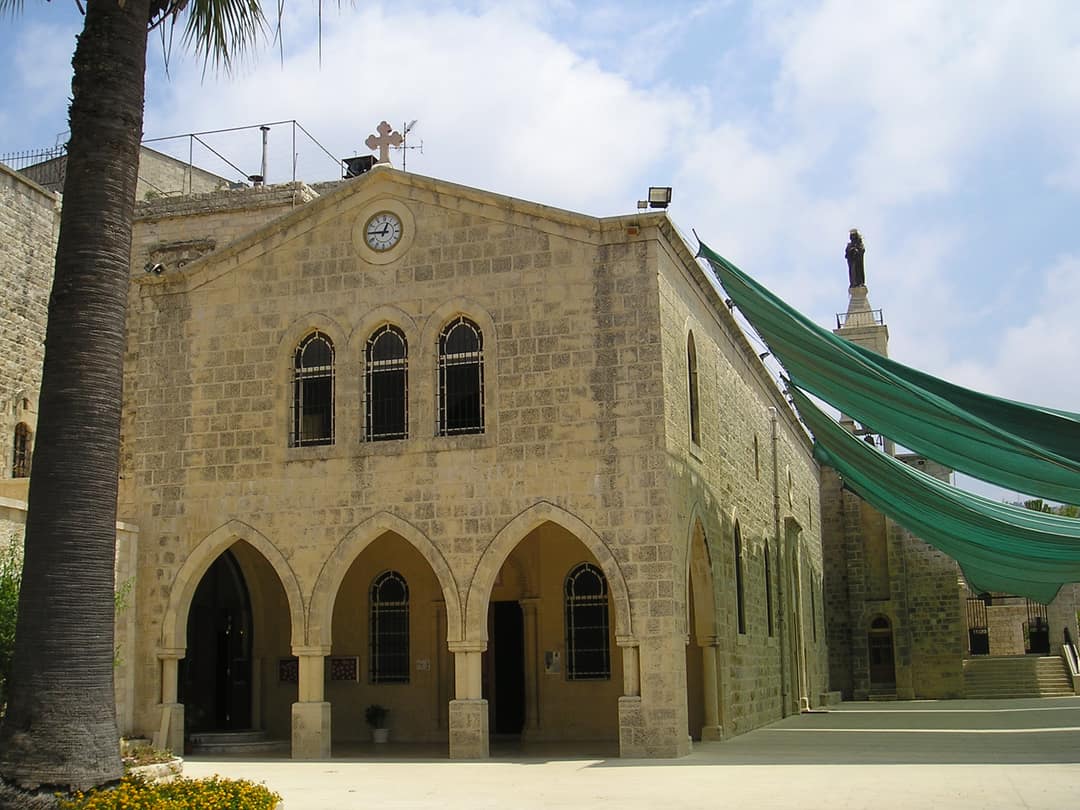
also spelled Deir al-Qamar, Deyr el-Qamar · elevation ~800 m · population ~4,494 (2024)
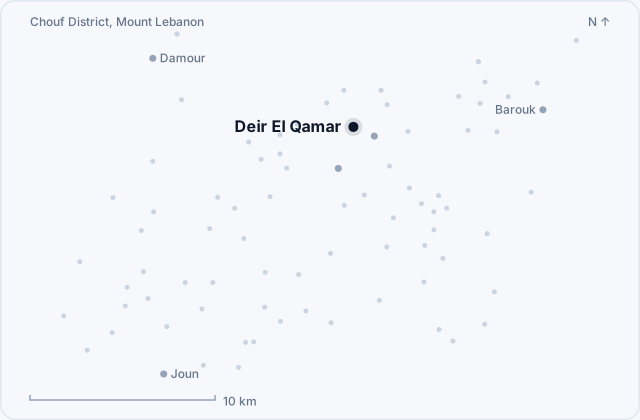
Deir El Qamar is in the Chouf District of Mount Lebanon, about 41 km from Beirut, about a 60-minute drive. Its closest Chouf neighbours are Beiteddine (~1.2 km), Bechtfine (~1.9 km) and Deir Koucheh (~2.0 km).
Shopping from Chouf-area stores and a directory of trusted local trades serving Deir El Qamar — without the trip out of the Chouf.
Free · works on weak signal · no app store needed
Deir al-Qamar sits at roughly 800 m elevation in the Chouf district of Mount Lebanon, about 5 km from Beiteddine. The town had an estimated population of 4,494 in 2024. Its preserved feudal architecture, stepped streets, walled gardens and winding cobbled alleyways are among Lebanon's best-kept historic urban fabrics; the local mix of a historic mosque, Maronite, Catholic and Greek Orthodox churches and a 17th-century synagogue reflects Lebanon's religious diversity. The town is also known for traditional embroidery produced by local women's associations.
By legend, Christian monks rebuilt a monastery by moonlight, so it was called Deir al-Qamar ('monastery of the moon'). A more specific local tradition holds that, while digging the foundations for the pillars of the main church of Saidet et Tallé, workers uncovered a rock decorated with a half-moon under a cross; the rock is now built into the church's old door and is cited as the source of the town's name. Freiha held instead that 'qamar' renders a Semitic moon-god whose temple the monastery replaced.
Deir al-Qamar served as the capital of the Emirate of Mount Lebanon from the 16th to early 19th centuries, ruled successively by the Maan (from 1590) and Chehab dynasties, until Emir Bashir Chehab II moved the seat of the emirate to nearby Beiteddine. It is recorded as the first municipality in Lebanon, established in 1860 (some local accounts, including statements by members of Deir el Qamar's municipal council, cite 1864). The town was the hometown of Camille Chamoun, Lebanon's second post-independence president (1952-58). During the 1975-90 civil war, the town — a Christian enclave in a mainly Druze area — was besieged for three months in 1983 and its residents displaced; post-war reconciliation between the Christian and Druze communities allowed a partial return, though only about 1,000 of an earlier population of more than 15,000 settled back permanently, with the population climbing to roughly 4,000 in summer.
registered population ~7,000 · ~41 km from Beirut
An 18th-century serail built into the hillside on several levels. Its courtyard was the scene of a massacre during the sectarian violence of 1860; the building now houses municipal offices and is noted for its stonework.
Built for Younes Maan, who governed Deir el-Qamar while his brother Fakhreddine was in exile in Italy. Now a private house, it is admired for its finely worked entrance.
A 20th-century folk-art castle about 2 km from town toward Beiteddine, built largely single-handed by Moussa al-Maamari to fulfil a childhood dream. Inside are mechanical tableaux of traditional Lebanese life and a large collection of weaponry.
A Caritas social health centre and a Ministry of Social Affairs Development Services Centre.
The heart of Deir el Qamar is the Midane, a large open square originally used for jousts and equestrian contests. Standing in it today is the Fakhreddine Mosque, built in 1493 and later restored by Fakhreddine I Maan for his Muslim mercenaries — the first mosque built in Mount Lebanon, square in plan with an octagonal minaret.
Just off the square, the Kaisariyyeh is an open market built in the classic khan style of the Mamluk and Ottoman eras, with a courtyard, a central fountain, and arched, shaded walkways. It once functioned as one of Lebanon's earliest commodities exchanges — prices for silk, olive oil, wheat and gold were fixed here and the resulting price list distributed across the country. It now hosts cultural events. Nearby, the restored Silk Souk still shows the arched alcoves that once sheltered silk traders.
The Serail of Youssef Chehab, an 18th-century building set into the hillside on several levels, now houses municipal offices and is known for its stonework; its courtyard was the scene of a massacre during the sectarian violence of 1860. The Fakhreddine II Palace today holds the Marie Baz wax museum, with effigies of figures from Lebanese history. A 17th-century synagogue, built to serve the town's Jewish community — some of whom were part of Fakhreddine II's entourage — still stands, though it is closed to the public and now used as a library by the French cultural center.
Deir el Qamar is often described as a UNESCO World Heritage Site in travel and tourism content, but the village is not inscribed on the World Heritage List and is not currently on Lebanon's UNESCO tentative list. It was nominated, together with Beit Ed-Dine, at the World Heritage Committee's 8th session (1984); the Committee took account of the site's importance to Lebanese national heritage but concluded that it did not meet the criteria of outstanding universal value required for inscription.
Seat of the Emirate of Mount Lebanon after Emir Bashir II moved the capital from Deir el Qamar; today the President of the Republic's summer residence and home to the annual Beiteddine Festival.
Privately built castle and museum on the Deir el Qamar–Beiteddine road; popular family-friendly stop.
First capital of the Maan emirate, neighbouring Druze town with a protected pine-and-oak HIMA forest.
Largest cedar forest in Lebanon and the country's largest nature reserve.
~41 km from Beirut · ~60 min drive
From Beirut, take the coastal highway south to Damour, then turn inland onto the Damour–Deir el Qamar road, which climbs through the Chouf to the town.
No. Despite frequent claims in travel content, Deir el Qamar is not inscribed on the UNESCO World Heritage List and is not on Lebanon's current tentative list. The village was nominated together with Beit Ed-Dine at the World Heritage Committee's 8th session in 1984, but the Committee found that the site did not meet the criteria of outstanding universal value required for inscription.
Deir el Qamar means 'Monastery of the Moon'. A local tradition holds that while digging the foundations for the pillars of Saidet et Tallé church, workers uncovered a rock decorated with a half-moon under a cross; the rock is now built into the church's old door. Another legend says monks rebuilt the monastery by moonlight, while the philologist Anis Freiha argued that 'qamar' refers to an earlier Semitic moon-god whose temple the monastery replaced.
Deir el Qamar is recorded as the first municipality in Lebanon, established in 1860; some local accounts, including statements by members of the town's municipal council, cite 1864 instead.
Deir el Qamar lies about 41 km southeast of Beirut, roughly an hour's drive. Take the coastal highway south to Damour, then turn inland onto the Damour–Deir el Qamar road that climbs through the Chouf Mountains.
Deir el Qamar served as the capital of the Emirate of Mount Lebanon — the historic political entity that preceded modern Lebanon — from the late 16th to the early 19th centuries, under the Maan and Chehab dynasties, until Emir Bashir Chehab II moved the seat of the emirate to neighbouring Beiteddine.
Deir el Qamar sits at roughly 800 m above sea level, on a hillside plateau in the Chouf district of Mount Lebanon.
Free · works on weak signal · no app store needed
More trades serving the Chouf area, reachable from Deir El Qamar:
Listing yourself on Chouf App is free, your number stays private, and it takes about a minute. Customers find you in the app and tap to call.
List your trade or place in Deir El Qamar — freePresence is a managed page on chouf.app that we build and keep current, so customers in the Chouf find you when they search.
Get your Deir El Qamar business found online